
Cleanroom Protective Coveralls Manufacturers: 7 Questions to Ask Before Choosing a Supplier
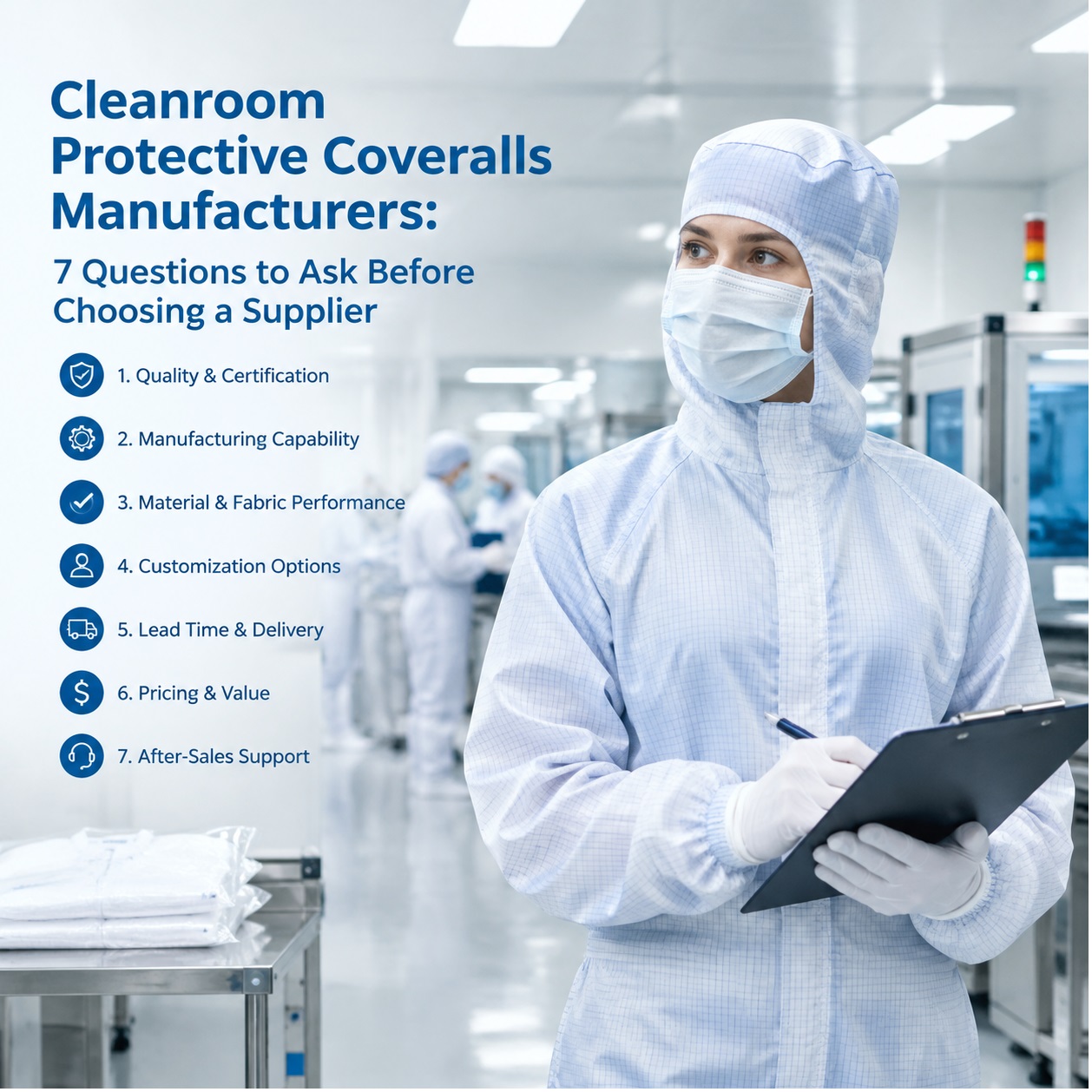 A single shed fiber can take down an entire production lot, and nobody notices until the batch fails. That is the reality of cleanroom sourcing. The cost of a bad coverall supplier never shows up on the invoice. It shows up later, in rejected wafers, failed sterility tests, and audits that suddenly get a lot less comfortable.
I have walked through garment factories on three continents and watched buyers spend weeks haggling over price per unit, then spend twenty minutes on the questions that actually decide whether their cleanroom stays clean. Here are the seven I would put on the table before signing anything.
- Are you the manufacturer, or a trading company with a nice website?
This one gets dodged more than any other. Plenty of suppliers present themselves as “manufacturers” while sourcing from a handful of workshops they have never audited themselves. Ask for the production address, then ask for a live video walkthrough of the cutting floor, the sewing lines, and the packing area. A real manufacturer will show you. A middleman will send you a catalog and a polite delay.
There is nothing wrong with trading companies in principle, but you deserve to know which one you are dealing with. When contamination issues arise, the distance between you and the actual production line is the distance between a quick fix and a month of finger-pointing.
- What exactly is the fabric, and can you prove its barrier performance?
“High-quality nonwoven” is not a specification. You want the exact material type, the weight in grams per square meter, the lamination structure if there is one, and the test standard behind the barrier claim. For particle and microbial barrier performance, look for documented results against recognized methods, not a marketing sentence.
Ask specifically about:
– Particle filtration efficiency and its test method – Microbial penetration resistance – Whether the fabric is antistatic or treated for static dissipation – How the material behaves after the sterilization method you use
If the supplier cannot produce a test report with a date, a lab name, and a sample description, you are buying hope.
- Which cleanroom class do your garments get sewn, inspected, and packed in?
This is the question that separates serious cleanroom garment makers from generic protective clothing factories. The manufacturing environment sets the ceiling on how clean the finished coverall can be. A garment sewn in an uncontrolled workshop and then “cleaned” afterward will never match one produced and packed inside an ISO Class 5 or better environment.
Ask for the classification of the actual rooms where cutting, sewing, and packaging happen. Ask whether those rooms are monitored continuously or just certified once a year. The answer tells you whether cleanroom discipline is a culture or a certificate on the wall.
- How do you control contamination during production?
Every step sheds something. Cutting blades, sewing needles, human skin, machine lubricants, packaging film. A competent manufacturer has a written answer for each one. Look for:
– Dedicated gowning procedures for workers entering production areas – Air shower or pass-through systems between zones – Needle control and broken-needle logging – Regular particle counting inside the production rooms – Defined handling rules for finished goods before they are bagged
Vague answers here are a warning sign. If they cannot describe their own process in detail, they probably do not control it.
- Can you trace a finished coverall back to its raw material batch?
Traceability sounds bureaucratic until the day you need it. If a customer audit or a quality incident requires you to identify which material lot went into a specific shipment, a good supplier can do it within hours. A weak one will tell you the records are “being checked.”
Ask how long they retain production records, how lots are numbered, and whether the fabric supplier’s certificates are filed alongside internal batch records. This is also a quiet test of how organized the company really is. Disorganized paperwork usually reflects a disorganized factory.
- How do you handle sizing, fit, and customization without compromising cleanliness?
A coverall that fits badly is a contamination risk. Loose cuffs drag. Tight shoulders tear at seams. Ill-fitting hoods let hair escape. So ask about your size range, whether they offer custom sizing, and how customization affects lead time and cleanliness.
Also ask about the details that quietly matter: taped versus serged seams, elastic versus knit cuffs, thumb loops, boot flaps, zipper covers, and whether the design has been validated for your specific gowning protocol. If the supplier offers to “match your current sample,” find out whether they reverse-engineer it properly or just copy the outside.
- What happens after the sale when something goes wrong?
Every supplier is pleasant during the quotation stage. The real character shows up when a shipment arrives with inconsistent seam quality, when a lead time slips, or when your audit team flags a documentation gap.
Ask for:
– Standard lead times and how they are protected during peak season – Their process for handling non-conforming goods – Whether they carry safety stock for repeat customers – Who your technical contact is, not just your sales contact – Their policy on recalls and replacements
A supplier who hesitates on these questions is telling you something. Believe them.
The bottom line
Cleanroom protective coveralls are not a commodity purchase, even though they are often priced like one. They sit between your process and the environment, and everything downstream depends on that barrier holding. The right manufacturer will welcome these seven questions, answer them with documentation, and invite you to see the factory for yourself.
The wrong one will keep talking about price. Let them. Your contamination control program is worth more than the discount they are offering.